


Sedona is known around the world for its red rock scenery, outdoor recreation, art galleries, and highly desirable residential properties. For buyers considering a luxury estate here, the purchase price is only one part of the financial picture.
Understanding Sedona luxury home property taxes is important before making an offer. Property taxes depend on the property’s assessed value, classification, taxing jurisdictions, and location.
Sedona is particularly interesting because the city extends across both Coconino and Yavapai counties, meaning the specific parcel matters when estimating annual taxes.
This guide explains how the system works in 2026 and what buyers should investigate before purchasing a high-value property.
Understanding Sedona Luxury Home Property Taxes
Sedona luxury home property taxes are calculated based on the assessed value of the property determined by the county assessor. Using a comprehensive Sedona luxury real estate tax guide helps buyers accurately estimate these annual carrying costs, ensuring their luxury investment in Red Rock Country remains financially sound.

Navigating Sedona, AZ Property Taxes and Jurisdictions
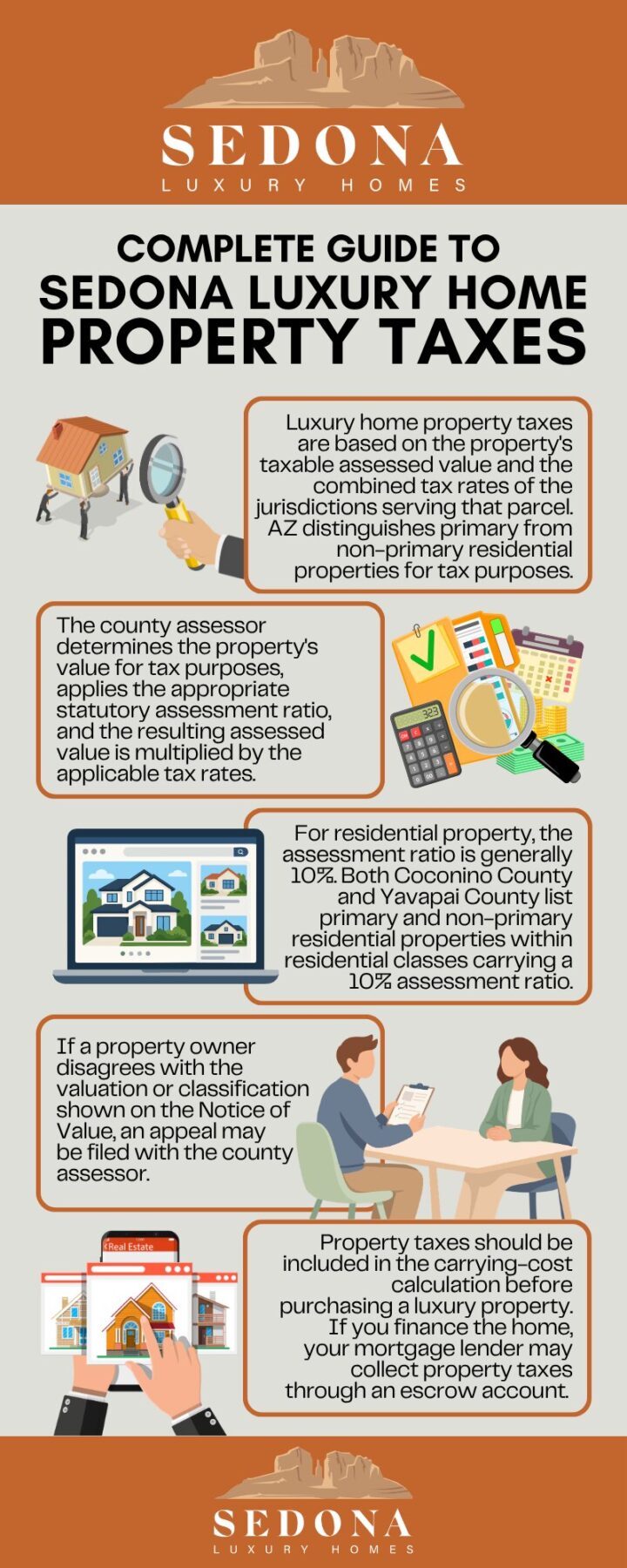
Sedona luxury home property taxes are based on the property’s taxable assessed value and the combined tax rates of the jurisdictions serving that parcel.
The county assessor determines valuation and classification, while local taxing districts establish the applicable rates. Buyers should review the property’s Limited Property Value, classification, tax district, and previous tax bills rather than estimating taxes from the purchase price alone.
Arizona’s property tax system does not simply apply one statewide percentage to a home’s sale price. Instead, the county assessor determines the property’s value for tax purposes, applies the appropriate statutory assessment ratio, and the resulting assessed value is multiplied by the applicable tax rates.
For residential property, the assessment ratio is generally 10%. Both Coconino County and Yavapai County list primary and non-primary residential properties within residential classes carrying a 10% assessment ratio.
Arizona also uses Limited Property Value (LPV) in its property tax system. LPV can differ substantially from a property’s market value, so a $3 million luxury home does not automatically have $3 million of taxable assessed value.
For a buyer, the most useful starting point is therefore the property’s actual county tax record.
County Line Considerations
One of the first questions buyers should ask about Sedona AZ property taxes is: Which county is the property actually in?
The City of Sedona crosses the boundary between Coconino County and Yavapai County. Consequently, two homes that appear to be in the same Sedona market can fall under different county assessment offices, tax districts, and combinations of taxing jurisdictions.
The city maintains geographic information showing its boundary in relation to the two counties. This distinction matters when comparing properties.
Coconino County, for example, publishes individual tax rates for numerous taxing districts. Its 2026 tax information shows that property-tax bills can include county, school, library, flood-control, health-service, fire, and other district components depending on the property’s location.
Yavapai County similarly explains that property taxes depend on the property’s value, property-use classification, and applicable taxing jurisdictions. Its 2026 example uses a 10% residential assessment ratio.
For this reason, buyers should obtain the parcel number and tax history before comparing the tax burden of two luxury properties.
Primary Versus Secondary Residence
A buyer’s intended use of a property can affect its classification.
Arizona distinguishes primary residences from non-primary residential properties for property-tax purposes. A qualifying primary residence falls under Class 3, while various non-primary residential properties fall under Class 4 classifications. The Arizona Department of Revenue states that primary-residence classification is relevant to eligibility for the homeowner’s rebate and other provisions of the state’s property-tax system.
A Sedona luxury home purchased as a full-time residence should therefore be reviewed differently from a vacation property, investment property, or other non-primary residence.
It is important not to assume that every primary residence receives a blanket “tax rebate.” Arizona’s homeowner rebate rules have specific requirements, and other property-tax credits have their own eligibility requirements.

The Current Market for Sedona Luxury Real Estate
Protecting High Value Equity
Luxury buyers should look beyond the headline purchase price when evaluating Sedona luxury real estate.
A property’s tax burden is influenced by its taxable value and tax district, not simply by whether the property is considered “luxury.” High-value homes can nevertheless generate significant annual tax bills because their taxable values can be considerably higher than those of ordinary residential properties.
Sedona’s limited supply of desirable land, distinctive scenery, and demand for high-end properties make careful due diligence especially important.
Rather than assuming that a home’s current tax bill will remain unchanged, buyers should examine its assessment history and understand how Arizona’s valuation system applies to that particular parcel.
Exploring Luxury Homes in Sedona
When touring luxury homes in Sedona, ask for more than the seller’s current property-tax bill.
A buyer should review several years of tax records when possible and ask about substantial improvements. Additions such as a new guest casita, expanded living area, major renovations, or other improvements can affect the property’s valuation.
A swimming pool may also be relevant, although the exact tax treatment depends on how the assessor values the property and improvements. Buyers should not assume that a specific improvement will automatically increase taxes by a predictable amount.
A useful due-diligence package can include:
- The latest county Notice of Value
- Current and prior property-tax bills
- Property classification
- Limited Property Value
- Full Cash Value
- Parcel number
- Applicable tax districts
- Information about recent improvements
- Any pending assessment appeal
This information gives buyers a much more realistic picture than an online tax estimate.

Partnering With Sedona Luxury Real Estate Professionals
The Value of Expert Representation
Buying a high-value home requires attention to details that can easily be overlooked during a fast-moving transaction.
Experienced Sedona luxury real estate professionals can help buyers investigate a property’s tax history, identify the correct county, review comparable properties, and understand how the property’s location affects its tax district.
They can also coordinate with the buyer’s lender, title company, tax professionals, and other advisers when questions arise during due diligence.
A knowledgeable agent should not promise that one neighborhood or county will automatically produce a lower tax bill. The actual tax burden depends on the individual parcel and its applicable jurisdictions.
Tax Assessment Appeals
Arizona provides a formal process for challenging a property’s valuation or classification.
If a property owner disagrees with the valuation or classification shown on the Notice of Value, Arizona Department of Revenue guidance states that an appeal may be filed with the county assessor.
For real property, the stated appeal period is generally 60 days from the mailing of the Notice of Value, subject to the applicable statutory rules and deadlines. Comparable sales can be useful evidence in a valuation dispute, but an appeal is not simply a negotiation over the home’s market price.
Buyers who believe an assessment is inaccurate should review the county’s valuation methodology and deadlines and consider consulting a qualified property-tax professional.

Budgeting for Your Sedona Luxury Home
Escrow and Monthly Carrying Costs
Property taxes should be included in the carrying-cost calculation before purchasing a luxury property.
If you finance the home, your mortgage lender may collect property taxes through an escrow account. The exact amount collected at closing depends on the lender, closing date, tax schedule, and existing tax payments or credits.
Buyers should not assume that the seller’s current tax bill will exactly equal their future expense. The property’s valuation, classification, tax rates, and applicable jurisdictions can change.
Beyond property taxes, a realistic luxury-home budget should also account for:
- Homeowners insurance
- HOA or community fees, if applicable
- Landscaping and exterior maintenance
- Pool maintenance
- Utilities
- Security
- Repairs and capital improvements
- Property management for second homes
Long Term Appreciation
Property taxes are an important recurring expense, but they should be considered alongside the broader financial characteristics of the property.
Luxury real estate should not be described as a guaranteed investment or a “safe harbor” for capital. Property values can rise or fall, and past appreciation does not guarantee future performance.
For buyers primarily purchasing a Sedona property for lifestyle reasons, the more useful approach is to determine whether the home remains financially comfortable after accounting for taxes, insurance, maintenance, financing, and other ownership costs.
Sedona Real Estate Tax Comparison Table
The following table provides a practical framework for comparing common property uses. Actual tax bills vary by parcel, county, classification, Limited Property Value, and taxing district.
| Property Classification | County Location | Anticipated Tax Burden | Residency Status |
|---|---|---|---|
| Primary Residence | Yavapai or Coconino | Determined by assessed value, classification,and local tax districts; qualifying primary residences may receive applicable homeowner treatment | Full-time occupant |
| Secondary Vacation Home | Yavapai or Coconino | Determined by assessed value, non-primary classification, and applicable tax districts; primary-residence benefits may not apply | Seasonal occupant |
| Short-Term Rental | Yavapai or Coconino | Property-tax treatment depends on its classification; short-term lodging can also create separate transaction privilege tax obligations | Transient / investment |
| Unimproved Land | Yavapai or Coconino | Generally based on the applicable land classification, valuation, and tax districts | Holding for build |
The distinction between property tax and other taxes is particularly important for short-term rentals.
Arizona treats lodging stays of fewer than 30 days under its transient-lodging tax framework, while residential rentals of 30 days or more are treated differently under state transaction privilege tax rules.
In other words, a short-term rental can involve tax obligations beyond the property’s annual real estate tax bill.
Secure Your Red Rock Legacy
Understanding Sedona luxury home property taxes should be part of the buying process from the beginning, not something addressed after an offer has been accepted.
Start by identifying whether the property is in Coconino or Yavapai County. Then review its classification, Limited Property Value, tax history, applicable taxing districts, and intended use.
Buyers should also distinguish between property taxes and other tax obligations that may apply to vacation rentals or investment properties.
Whether you’re searching for a Sedona luxury home, comparing luxury homes in Sedona, or evaluating an investment in Sedona luxury real estate, accurate property-tax information can help you calculate the true cost of ownership.
Working with experienced Sedona luxury real estate professionals can make the due-diligence process easier and help ensure that tax considerations are incorporated into the overall purchase decision.
If you’re considering buying a luxury property in Sedona and want help evaluating the property’s tax history, location, carrying costs, and overall purchase considerations, call 928-264-7548 or email info@sedonaluxuryhomes.com.
Frequently Asked Questions
The main difference is not necessarily a single countywide tax rate. Each county has different taxing districts, levies, assessment records, and applicable jurisdictions. A property’s exact location determines which combination applies. Both counties use a 10% assessment ratio for standard residential property classes, but the final tax bill depends on the property’s taxable value and applicable district rates.
It should distinguish property taxes from transaction privilege taxes. Arizona treats stays of fewer than 30 days as transient lodging for TPT purposes, while residential rentals of 30 days or more have different rules. Owners considering a short-term rental should verify both property-tax classification and lodging-tax requirements before operating the property.
They can help you understand the assessment, gather relevant property information, and provide market data that may assist with your due diligence. However, the formal appeal is made through the applicable county assessor process. Arizona generally provides a 60-day period for appealing a real property’s Notice of Value.
There is no separate statewide “luxury home tax” in Arizona. Property taxes are determined through the state’s assessment system and local taxing jurisdictions. Scottsdale properties are generally in Maricopa County, while Sedona properties can be in either Coconino or Yavapai County. A meaningful comparison requires looking at specific parcels and their tax districts rather than comparing luxury-home prices alone.
A pool or other substantial improvement can affect a property’s valuation, but the change is not a fixed dollar amount. The county assessor determines property value under Arizona’s assessment rules. Buyers considering a major renovation should account for the possibility that improvements can affect future valuation.
Arizona property taxes are generally billed in two installments rather than requiring homeowners to make monthly payments directly to the county. If a homeowner has a mortgage with an escrow account, however, the lender may collect a monthly amount toward the anticipated annual property-tax obligation.
A luxury home’s price alone does not determine eligibility. Arizona distinguishes primary residences from non-primary residential property, and qualifying primary residences may receive applicable homeowner treatment under state law. Eligibility depends on the property’s classification and the owner’s circumstances.